
When Your Dunnage Has to Be Big, Tough, and Light
TL;DR: Structural foam injection molding creates parts with a solid outer skin and a foamed core. That combination delivers stiffness without the weight, which makes it ideal for large shipping trays, seat pallets, and rack dunnage that operators or robots need to move thousands of times. This guide breaks down where structural foam wins, where other processes make more sense, and how Vantage Plastics and LOTIS Technologies use it as one tool inside a complete packaging system.
The Problem That Keeps Dunnage Designers Up at Night
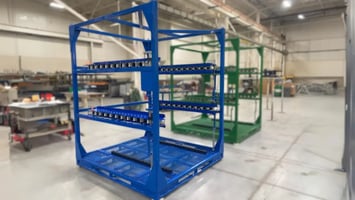
You need a shipping tray the size of a card table. It has to protect critical surfaces on every trip. It has to survive years of handling. And someone still needs to lift it, or a robot needs to pick it without straining the system.
Standard injection molding can make you a big part, but the clamp force required gets expensive fast. Thermoforming can give you a big part quickly, but thick structural ribs and consistent wall properties are harder to achieve when you are stretching sheet.
Structural foam injection molding sits between these options. It gives you the structural geometry of injection molding with a density advantage that makes large parts practical to handle and produce.
How Structural Foam Works (In Plain Language)
Think of it like a waffle cone versus a solid ice cream cone. Both are strong enough to hold your dessert, but the waffle version uses less material and weighs less because of the air pockets inside.
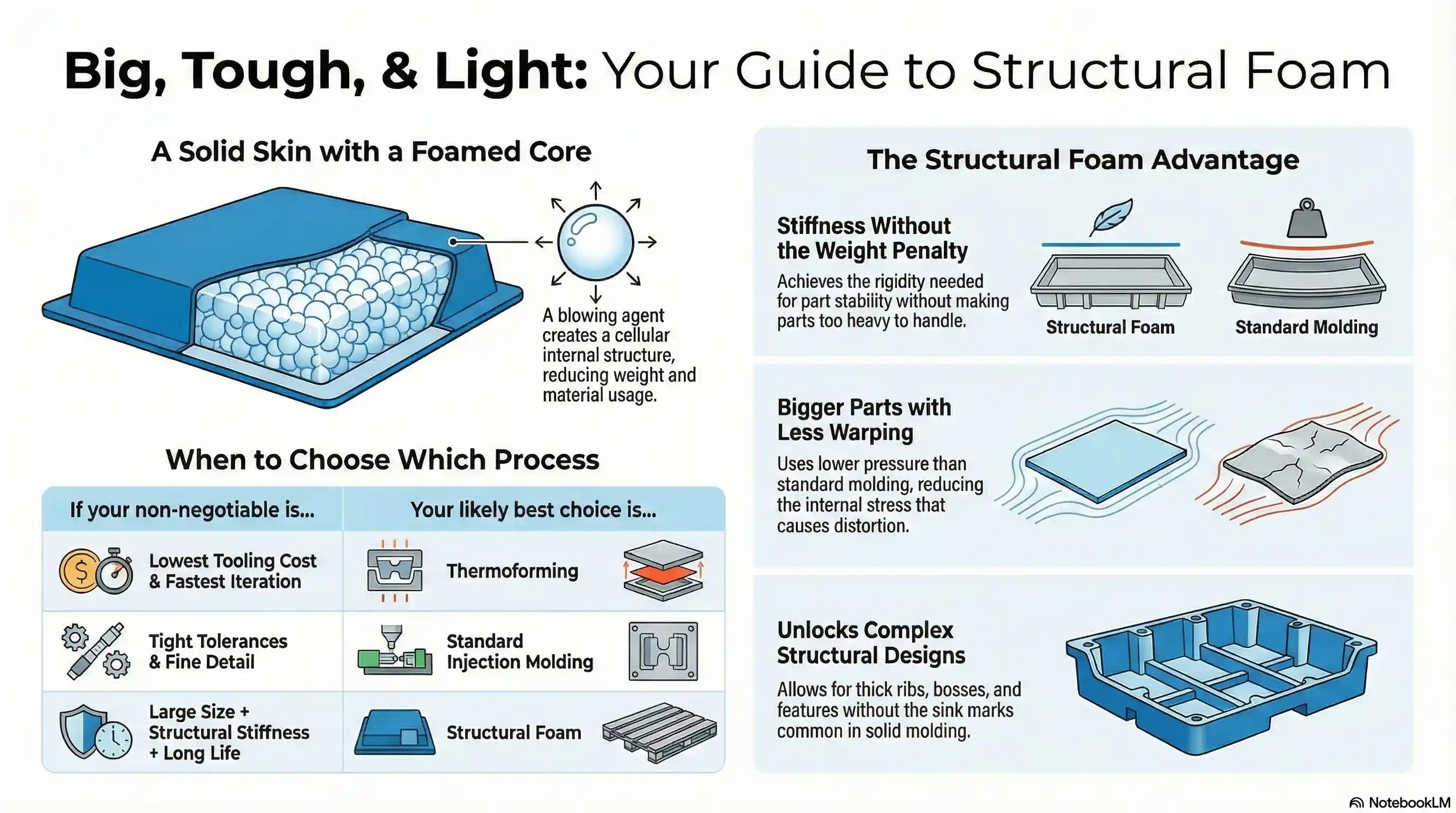
In structural foam injection molding, a blowing agent creates a cellular structure inside the part during the molding process. The outside stays solid (the "skin"), while the inside contains a controlled foam core. That foam displaces resin volume, so you get a lighter part without giving up stiffness.
The process also uses lower injection pressure than conventional molding. Where a standard injection part might need three to four tons per square inch of projected area, structural foam can operate closer to one ton. That difference changes what is possible on a given press and reduces the internal stress that causes warpage in large parts.
Five Reasons Structural Foam Wins for Large Returnable Packaging
1. Stiffness Without the Weight Penalty
In dunnage, weight is not just a freight cost. It affects whether an operator can safely handle the tray, how fast a line-side cell can cycle, and whether automation can move the packaging without oversizing the equipment.
Structural foam delivers meaningful weight reduction compared to solid molding while retaining the rigidity that keeps parts flat and stable over thousands of cycles. At LOTIS Technologies, we position structural foam as the go-to process when the component needs to be big, tough, and still light enough for real-world handling.
2. Lower Clamp Force Means Bigger Parts Are Practical
Lower injection pressure does more than make the process easier. It reduces the molded-in stress that leads to warpage and distortion. It also expands feasible flow lengths and thick-wall designs that would otherwise hit packing limitations.
For dunnage, this translates into straighter parts, better nesting and stacking behavior, and fewer "mystery fit" issues when the packaging hits the field.
3. Design Freedom for Thick Ribs and Structural Features
Returnable packaging often needs ribs, columns, bosses, and interfaces for conveyors, robots, or rack engagement. Traditional injection molding imposes strict rules about rib-to-wall thickness ratios to avoid sink marks on the opposite surface.
Structural foam loosens those constraints. The foaming action changes how features pack out, so you can design the structural geometry you actually need instead of compromising around process limitations.
4. Dimensional Stability on Parts That Would Otherwise Fight You
Large, thick sections are notoriously difficult to hold flat. In solid molding, uneven cooling and high packing pressure create internal stress that shows up as warpage after ejection.
Structural foam's lower pressure and cellular core reduce those forces. The result is parts that stay where you put them and interfaces that align the way the CAD said they would.
5. A Sustainability Story That Actually Holds Up
Structural foam uses less resin per part by design. That is a direct material savings. At Vantage Plastics, we take that further with a vertically integrated recycling loop.
Edge Materials Management, our industrial recycling division, specifically processes HDPE and PP structural foam streams. That means the end-of-life path for your structural foam dunnage is already built into our system. The material comes back to AirPark Plastics for sheet extrusion or feeds directly into new injection molded components. It is not a marketing promise. It is how we operate.
Where Structural Foam Fits in the Vantage Toolbox
Vantage Plastics spans thermoforming, injection molding (including low-pressure structural foam), sheet extrusion, and recycling. LOTIS Technologies is our injection molding powerhouse, running presses from 185 to 1,100 tons with access to larger capacity when programs demand it.
For our customers, that means structural foam is one option inside a complete packaging system:
Thermoforming handles large surface-area trays, covers, and lightweight geometries where tooling cost and development speed matter most.
Structural foam injection molding takes over when you need thicker structural geometry, long-life repeatability, and stiffness for returnable assets that run for years.
Standard injection molding delivers the detailed interfaces, clips, latches, inserts, and tight-tolerance features that thermoforming cannot practically produce.
Many programs combine all three. The optimal answer is rarely a single process. It is a system design where thermoformed shells, injection-molded detail components, and structural foam bases work together to hit cost, durability, and automation targets.
When to Choose Structural Foam Over Standard Injection Molding
Structural foam usually wins when you need:
- Large projected-area parts where clamp tonnage becomes a cost driver
- Thick-wall strength without fighting sink marks and warp
- Material reduction and lighter handling with stiffness retained
Standard injection molding still wins when you need:
- Class A cosmetic surfaces (structural foam can show swirl and flow effects unless special methods are used)
- Very fine detail, tight tolerances, or thin walls
- High-volume economics in multi-cavity tools where the part fits within realistic press constraints
When to Choose Structural Foam Over Thermoforming
Thermoforming is often the fastest route to a large part because tooling is simpler and less expensive, and development cycles tend to be shorter.
But the processes behave differently in ways that matter for dunnage.
Thermoforming usually wins when you need:
- Large, shallow-to-moderate draw trays where lightweight packaging needs to move fast
- Rapid iteration when the program is still evolving
- Aesthetic surfaces because you can start with textured or colored sheet and form that finish into the part
Structural foam usually wins when you need:
- Consistent section properties (thermoforming stretches sheet, which thins corners and high-draw regions)
- Integrated structural features like deep ribs, bosses, and rack interfaces molded in one shot
- Long-life repeatability for automation systems that cannot tolerate variation in wall thickness or flatness
The Constraints You Need to Plan For
Structural foam is not magic. It requires disciplined process control and smart design.
Surface expectations
Structural foam can show swirl and flow effects on the surface. If your packaging is customer-facing or must protect Class A finishes, you may need a texture strategy, process variants, or a different process for the outer surface.
Design rules still matter
Lower pressure relaxes some constraints, but you still need proper wall strategy, venting, gating, and cooling design. LOTIS emphasizes "design for molding" early to avoid expensive late changes.
Equipment and mold scale
Large parts are feasible, but physics still applies. Platen size, shot size, and handling constraints set upper limits. The clamp force advantage helps, but it does not eliminate the need to match the part to the press.
A Quick Decision Framework
If you are choosing between thermoforming, standard injection molding, and structural foam for a large returnable packaging program, start by identifying what is truly non-negotiable:
If the non-negotiable is lowest tooling cost and fastest iteration, thermoforming often leads.
If the non-negotiable is tight tolerances and intricate molded detail, conventional injection tends to lead.
If the non-negotiable is large size plus structural stiffness plus long life, structural foam is frequently the best center point.
For most automotive and industrial dunnage systems, the optimal answer combines processes. Thermoformed shells, injection-molded detail components, and structural foam bases working together. That integrated approach is exactly how LOTIS and Vantage operate.
Why This Matters for Your Sustainability Story
OEMs under cost pressure and sustainability reporting pressure need a commercially legible story. Structural foam, combined with our vertically integrated recycling infrastructure, gives you that story:
- Engineer a lighter, tougher returnable asset
- Reduce damage and downtime risk
- Recover material at end of life through Edge Materials Management
- Feed that material back into production through AirPark Plastics
That is not aspiration. It is how we run programs today.
What Happens Next
If you have a dunnage program that needs to be big, tough, and light, we can help you figure out where structural foam fits (or does not fit) in your system.
Bring us your part CAD and constraints. We will walk through your requirements, run the analysis, and show you how the process can be engineered around your program instead of the other way around.
Sources and Further Reading
- How Injection Molding Works at LOTIS Technologies
- Thermoforming vs Injection Molding: Supply Chain Efficiency
- Improved Cost Efficiency in Structural Foam Molding (ENGEL)
- Edge Materials Management (Vantage Plastics)
- Injection Molding vs Thermoforming Comparison (Xometry)
- SPE Thermoforming Division Training Materials