

.webp?height=200&name=plastic%20pallets%20supply%20chain%20(1).webp)
Efficient supply chain management is the foundation of successful logistics operations. Pallets, as...
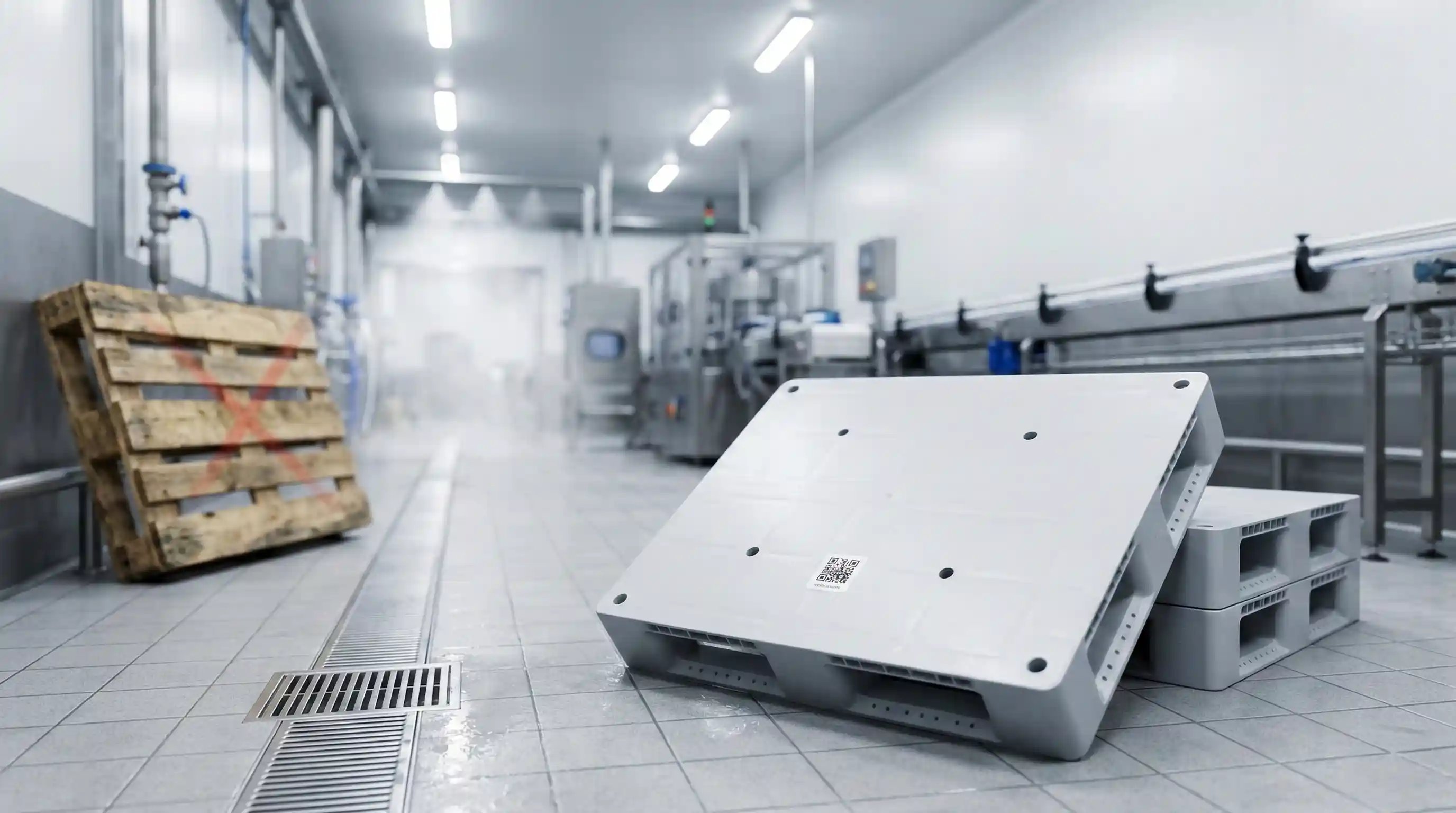
If you operate a food or beverage facility, wood pallets can become a persistent problem in washdown zones, cold storage, and high-traffic docks. The issue is not whether wood can move product. The issue is hygiene consistency, physical contamination risk, and how well pallets perform in modern, automation-heavy material handling.
In most washdown and hygiene-sensitive applications, a purpose-built plastic pallet is the best alternative to wood. It is non-porous, easier to sanitize, dimensionally consistent, and generally safer for people and product.
This guide explains why, what to look for in a food-grade pallet program, and how the Vantage family supports pallet systems that reduce risk, improve uptime, and support circularity.
Why wood pallets create avoidable risk in food environments
Hygiene variability in wet or washdown conditions
Washdown environments expose wood’s biggest weakness: it is porous and degrades over time. Moisture retention, cracks, repairs, and surface wear increase the chance of soil retention and make consistent sanitation harder.
Food safety guidance commonly points out that non-wood materials like plastic are preferable in processing areas because they can reduce microbial harborage and cross-contamination risk. In practical terms, plastic pallets offer more predictable sanitation outcomes because surfaces are non-porous and more repeatable to clean.
Physical contamination and foreign material exposure
Foreign material risk is a recurring topic in food operations. Wood pallets add common foreign material pathways such as splinters, nails, broken boards, and loose fasteners.
Plastic pallets eliminate the splinter and nail class of hazards. For many plants, that alone simplifies preventive controls, reduces incident investigations, and lowers the chance of packaging or product damage tied back to pallet failures.
What “best alternative” actually means: hygienic plastic pallets designed for washdown
Not every plastic pallet is automatically a fit for washdown, food, or automation. The goal is a hygienic, washdown-ready plastic pallet that can survive your cleaning regimen and handling environment without turning into the next problem.
Here is what that should mean in a buyer spec:
Core characteristics you should demand
- Non-porous, smooth surfaces that can be washed and sanitized repeatedly
- Minimal cavities and trap points to reduce soil and moisture retention
- Chemical and temperature resistance matched to your real washdown process
- Consistent dimensions for conveyors, palletizers, AGVs, and racking
- No splinters, no protruding nails, no loose boards, and fewer surprise failures
Durability and ROI: use “trips” as your decision metric, not purchase price
The wood-vs-plastic debate often stalls at unit cost. The better comparison is cost per trip and failure rate.
A simple model:
Cost per trip = (pallet cost + cleaning + tracking + loss + replacements) ÷ expected trips
If your operation is fighting pallet damage, sanitation variability, product damage, or automation jams, the “trips” model typically makes the ROI easier to justify than unit price.
Academic and industry testing frequently highlights that plastic pallets can deliver far more handling cycles than standard wood pallets in repeated-use environments. The exact trip count depends on pallet design, loads, racking conditions, and handling practices, but the point remains consistent: durability changes the economics.
Automation and pallet performance are tied together
Warehouse and plant automation has one brutal requirement: standardization. If pallet geometry varies, surfaces warp, or entry points are inconsistent, automated systems struggle.
Plastic pallets are often preferred in automated environments because they can offer:
- Tighter dimensional consistency (less conveyor and palletizer friction)
- Repeatable handling features (fork entry and nesting behavior)
- More predictable performance in racking and stacking
Traceability and loss control: RFID and QR can turn pallets into assets, not consumables
In food logistics, pallets are increasingly treated as trackable assets. RFID and QR identification can reduce loss, speed investigations, and support traceability workflows when something goes wrong.
If pallet loss is high or your supply chain needs tighter accountability, identification features become more than a “nice to have.” They become a measurable ROI lever.
Where the Vantage family fits for food-grade pallet programs
When a buyer searches for “food-grade pallets,” they are usually not buying a pallet only. They are buying a program: consistent supply, reliable performance, optional tracking, and an end-of-life plan that does not become a disposal headache.
The Vantage family is positioned to support that program approach because it can align:
- Manufacturing capability for durable, repeatable pallet systems
- Design support to match hygiene, washdown, cold-chain, and automation requirements
- Circularity and end-of-life recovery through an internal recycling pathway
That combination matters to procurement because it reduces vendor handoffs and creates a clearer lifecycle plan for returnable assets.
Sustainability: address it directly, without overselling
Sustainability comparisons between wood and plastic are nuanced. Wood can look favorable in some one-trip footprint comparisons. Plastic often looks better when reuse cycles are high, damage is reduced, and end-of-life recycling is built into the program.
The practical position for food operations is:
- Choose the option that reduces damage, improves sanitation consistency, and maximizes reuse cycles
- Build an end-of-life plan so pallets are recovered and recycled rather than discarded
Buyer checklist for RFQs
When requesting quotes, specify:
- Washdown chemicals, temperatures, and frequency
- Static, dynamic, and racking loads
- Closed deck vs vented deck requirements
- Automation touchpoints (conveyors, palletizers, AGVs, racking type)
- Tracking needs (RFID or QR) and data expectations
- Cleaning ownership (in-house vs pooling service)
- End-of-life plan (take-back, buy-back, or recycling pathway)
- Handling and inspection standards you will enforce (training matters)
What's Next
If you are replacing wood pallets in washdown, cold-chain, or high-hygiene areas, the fastest path to a correct spec is a short pallet audit: where pallets travel, how they are cleaned, how they are stored, and where failures occur. From there, a properly designed plastic pallet system can reduce foreign material risk, improve sanitation consistency, and support automation and tracking.
Sources
- FDA: Guidance for industry on minimizing microbial food safety hazards in fresh-cut fruits and vegetables (discussion of wood and preference for non-wood materials in processing areas)
- USDA APHIS: Import requirements for wood packaging material (ISPM 15 treatment and marking requirements for wood packaging)
- Washington State Food Code materials guidance: Requirements describing durable, nonabsorbent, smooth, easily cleanable surfaces able to withstand repeated washing
- USDA FSIS: Foreign material as a hazard category in food safety programs (foreign material examples include wood-related contamination pathways)
- Food Safety Magazine: Articles on foreign-object contamination pathways and on plastic pallets in food environments (hygiene, splinter avoidance, RFID and traceability discussion)
- Penn State (research/news summary): Wood vs plastic pallet lifecycle and durability tradeoffs
- Virginia Tech study summary (via logistics trade coverage): Comparative durability testing of plastic vs wood pallets under repeated handling

