
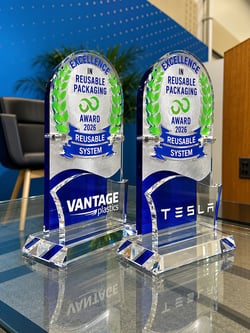
Winner of the 2026 Reusable System Award from the Reusable Packaging Association, presented at PACK EXPO International in Chicago on October 20, 2026.
Tesla turned to Vantage Plastics for engineered packaging expertise for Powerwall 3, its residential battery system. The partnership produced a reusable protective packaging system that eliminated cardboard shipping packaging. The program has saved millions of pounds of cardboard waste, with further sustainability savings yet to be captured. The reusable system supports Powerwall 3 deliveries to installation sites across four continents.
Powerwall 2, the preceding residential battery generation, was shipped using a package heavily reliant on cardboard and disposable plastic components. Powerwall 3 adds an integrated solar inverter and higher power output to support household electrical loads. As Tesla advanced its battery technology, the packaging presented an opportunity to reduce the disposable materials associated with delivery and installation.
The collaboration earned Tesla and Vantage Plastics the 2026 Reusable System Award from the Reusable Packaging Association, recognizing an operating business-to-business reuse program rather than packaging design alone. The award is judged by an independent panel of industry experts, with evaluation weighted toward project implementation (30%), demonstrated business or economic improvements (35%), and environmental improvements (35%). The association reports more than 280,000 packaging return-and-reuse events at Tesla’s Gigafactory Nevada. The result demonstrates how packaging engineering, coordinated returns, and material recovery can work together.
From Disposable Packaging to Reusable Protection
The Powerwall 2 shipping configuration relied on cardboard, protective foam, plastic film, and other disposable materials, estimated by Vantage at no less than 29 pounds per shipment. Tesla initially asked Vantage to address shipping damage, including punctures associated with cardboard packaging that was also vulnerable to moisture, crushing, and repeated handling. Vantage recognized an opportunity to address both protection and disposable packaging waste. Vantage designer Nathan Ostroski identified a broader opportunity and proposed a reusable protective packaging system to replace the cardboard shipping package and much of the accompanying disposable material.
Vantage developed the solution through thermoforming, a process that forms heated plastic sheet using molds to produce precisely engineered protective components. The resulting design met Tesla’s handling and distribution needs while allowing the packaging to be used repeatedly. Engineering the solution also meant fitting existing automation and handling processes and the dimensional constraints of vans, trucks, and the distribution network.
Keeping Packaging in Circulation
The reusable protective packaging system was designed for up to 200 uses, moving through production, transportation, distribution, installation, and return. Making that repeated use practical requires a way to bring empty packaging back into circulation. Each completed reuse can avoid the recurring purchase, production, transport, and disposal of another disposable packaging set, subject to the costs of operating the return loop.
Distributors, installers, and consumers support the return process. The Powerwall 3 returnable packaging is returned to Tesla and a credit or deposit is issued, incentivizing and fueling the returnable loop system. The program achieves a return rate of approximately 65–70%, substantially exceeding the initial planning expectation of 25%. These returns keep reusable packaging in service and reduce the need for replacement packaging.
Vantage helps manufacturers develop economic loops from the outset: engineering durable protective packaging, defining workable return pathways and incentives, and planning for material recovery at the end of service life. Customers do not need an established return network before beginning this work. Evaluating that loop also means testing whether packaging can be collected after installation, whether participants will return it, and whether avoided recurring costs justify the return operation.
Recovering Material at End of Life
Vantage and Tesla are already working together to reclaim Powerwall 3 packaging components after their useful life. Vantage has received returned components for material reclamation, extending the program beyond reuse into recovery of the plastic itself. This approach keeps packaging in productive use before its plastic is recovered for recycling when it can no longer serve its original purpose.
Vantage’s broader material-management capabilities include a guaranteed buyback program for eligible worn, damaged, or obsolete plastic packaging, helping preserve residual material value. Through Edge Materials Management, recovered plastics can be processed for potential use as manufacturing raw material. The Powerwall 3 program aims to reclaim all eligible packaging components and minimize waste. The quantity processed and specific subsequent applications have not yet been confirmed. A full environmental assessment must also account for the reusable packaging itself, reverse transportation, processing, and end-of-life recovery.
A Partnership Other Manufacturers Can Apply
Tesla’s objective to reduce disposable packaging led Nathan Ostroski and Vantage to develop a reusable protective packaging system. Tesla and its distribution partners established a return process, and returned components are now entering material reclamation. Together, these steps show how packaging can become a circulating asset rather than a single-use expense.
Other manufacturers can pursue a similar model with Vantage, whether they have an existing return process or need help establishing one. Vantage connects protective packaging design, return logistics, appropriate incentives, and end-of-life recovery into a practical operating system. That expertise extends beyond Tesla to work with most major automotive OEMs and into markets including government, beverage, and consumer products. For manufacturers considering this model, the potential advantage is both environmental and economic: fewer disposable packaging purchases and less material waste over repeated shipping cycles.
Congratulations to Nathan Ostroski, the Vantage Plastics team, and our partners at Tesla on this recognition.


About the Author
George D. Aultman is Vice President of Strategic Development at Vantage Plastics and a member of the Board of Directors of the Reusable Packaging Association. Through Vantage Perspectives, he shares insights on packaging engineering, manufacturing, material management, and reusable packaging systems.